
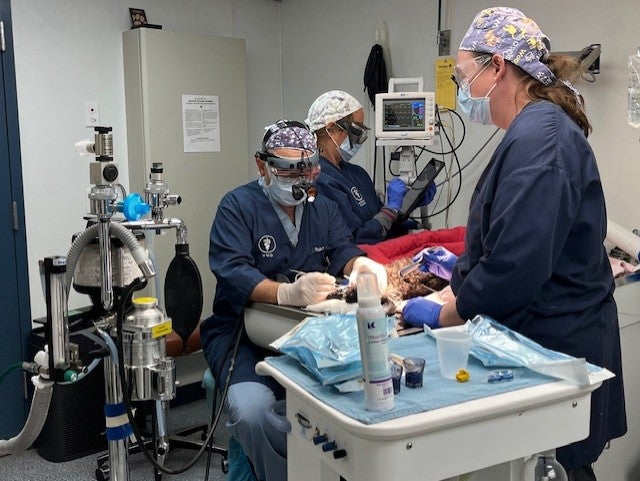
 Veterinarians wear many hats. We are your pet’s pediatrician, internal medicine doctor, radiologist, cardiologist, surgeon and also dentist. All dogs and cats need regular oral health care and the veterinarian and LVT (licensed veterinary technician) are the best sources of dental information. Proper dog dental care plays an important role in overall health, and understanding your pet’s teeth and gums is the first step toward disease prevention.
Home Oral Hygiene
Teeth are teeth no matter whose mouth they are in. All teeth need regular home oral hygiene in the form of daily brushing. The mechanical action of the brush is more important than any product in removing plaque, the film that collects on your pet’s teeth. Plaque mineralizes very quickly, within days, to become visible calculus. Calculus can only be removed with professional instruments. No oral solution or even brushing can remove calculus. This buildup is one of the leading causes of dental disease in dogs and periodontal disease in dogs.
A list of oral hygiene products approved by the Veterinary Oral Health Council (VOHC) can be found at www.vohc.org. These may include dog dental chews, dental treats for dogs, dog teeth cleaning treats, dental wipes for dogs, dental wash for dogs, and dog teeth cleaning toy options that help support healthy teeth between professional cleanings. These products can be helpful for pet owners searching for the best dental chews for dogs or vet recommended dog dental chews.
Why Professional Dental Care Is Needed
Despite diligent home oral health care (and especially in its absence) regular professional dental health care provided by the veterinary team is required. Think about it. You likely floss your own teeth every day, brush at least twice daily maybe with an ultrasonic toothbrush. You may even use a water flosser every day, but you still (should) see your dentist at least twice a year for a professional examination and prophylaxis (cleaning). The real difference is that dogs and cats require general anesthesia for this. Professional dog dental cleaning allows for a complete oral examination and treatment that cannot be safely performed on an awake pet.
Yes, there are people, even some veterinarians, who offer anesthesia free dog teeth cleaning. Even the most cooperative dogs and cats allow limited, at best, access to their mouths. It is unlikely that they will allow anyone to probe under the gumline, where periodontal disease occurs or on the tongue side of their teeth. Dental x-rays are impossible to perform on awake pet. Dental x-rays are as important to dental health in animals as they are for humans. Remember that your pet cannot tell you if or where it hurts.
Signs of Dental Disease
Signs of dental disease include:
- Diminished appetite
- Difficulty chewing or chewing preferentially on one side of the mouth
- Dropping food
- Reluctance to eat hard food
- Halitosis
- Visible calculus and gingivitis
- Resistance to allowing people to touch or handle the face or mouth
Other signs can include facial swelling below the eye, epistaxis (nose bleeds) and increased sneezing. Many pet owners first notice dog bad breath and dog owners may search for how to fix it. A dog has bad breath when bacteria accumulate along the gumline resulting in plaque buildup, infection, and periododntal disease. Professional dental care is needed.
Professional Oral Care and COHAT
Professional oral care starts with a physical examination. If there is calculus and especially gingivitis (gum inflammation) the veterinarian will advise you that a Comprehensive Oral Health Assessment and Treatment (COHAT) is indicated. Some pre-anesthetic blood tests will be recommended to look for systemic health issues that could complicate anesthesia.
If your pet has a cardiac murmur or is 10 years of age or older pre-anesthetic chest x-rays will be recommended as well. All of this is to ensure that your pet can be safely anesthetized.
On the morning of the COHAT there will be one more physical exam to ensure that there have been no changes in your pet’s physical condition. It also gives the veterinary staff an opportunity to address any questions that you may have before the procedure.
Your pet will be given some pre-anesthetic medications that provide analgesia and sedation. An intravenous catheter will be placed and general anesthesia induced. Your pet will be intubated to administer gas anesthesia and to protect the airway from aerosolized dental calculus and ultrasonic cleaner spray.
Dental Cleaning and Examination
Once the teeth are cleaned using an ultrasonic cleaner and curettes a thorough oral exam is conducted checking for periodontal pockets around every tooth. The soft tissues of the mouth are examined, and x-rays are taken of all the teeth. This level of care is recommended even for pets receiving routine brushing at home.
Next each surface of each tooth is polished with a dental pumice and fluoride is applied. Just imagine doing this on a non-anesthetized patient. The average amount of time to do this is 60-90 minutes depending on the size of the patient and the amount of calculus that is present.
Dental Extractions
If significant dental pathology is present dental extractions may be indicated. Other oral lesions, like gingival hyperplasia (overgrowth of gum tissue) and oral tumors can also be found when the mouth is examined under anesthesia. Depending on the situation these may be addressed at this time or documented and scheduled for a second procedure after further discussion with you. Your veterinarian may also discuss treatment options if advanced dental disease in dogs is identified during the procedure.
After the Procedure
Your pet will be discharged the same afternoon.
The benefits of all of this include:
- A pet with much better smelling breath
- Greater oral comfort
- A greater likelihood of retaining all of the teeth
Home oral maintenance will help prolong the benefits of professional cleaning. This may include brushing, dog dental chews, dental bones for dogs, dog dental toy options, and learning how to clean dog teeth without brushing when brushing is not possible. Pet owners often ask how to clean dogs teeth, best way to clean dogs teeth, or how to clean your dog's teeth naturally — your veterinary team can recommend the safest and most effective options.
Long-Term Oral Health
Taken all together, paying attention to your pet’s oral health will help keep him or her happy and healthy. Routine exams, professional dog dental cleaning, and consistent home care help prevent dog bad breath, periodontal disease in dogs, and other dental problems. It is another way that County Animal Hospital Cares About Health.